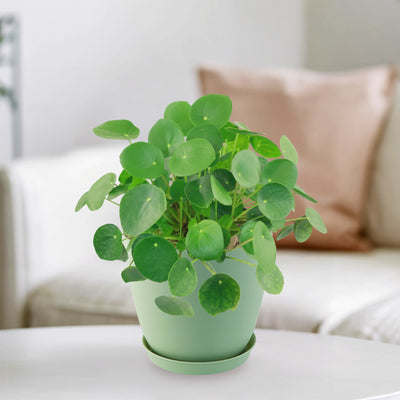
chinese money plant humidity Shop 'Chinese Money Plant – Pilea peperomioides' Care & Info
SKU: 34874904450
chinese money plant humidity

chinese money plant humidity Shop 'Chinese Money Plant – Pilea peperomioides' Care & Info

Sale price$22.91 Regular price$25.45
Save 10%

Pay in installments of $6.36 with ShopPay, AfterPay and Klarna

Shipping Estimate
USA
  • USA
  • CAN

Ships within 48 hours · Estimated delivery Jun 30 - Jul 5

Promo Codes Available:

For Your Every Summer RSVP, with Code: SUMMER15

Description

chinese money plant humidity Shop 'Chinese Money Plant – Pilea peperomioides' Care & InfoThe Chinese Money Plant, known as Pilea peperomioides, is one of the most beloved houseplants in the world, admired for its coin shaped leaves, minimalist look, and ease of care. Often seen gracing modern interiors and Instagram feeds, this quirky plant brings a charming architectural quality to any space. Traditionally, the Chinese Money Plant is believed to bring prosperity, good fortune, and financial abundance, which is why its often given as a

The Chinese Money Plant, known as Pilea peperomioides, is one of the most beloved houseplants in the world, admired for its coin-shaped leaves, minimalist look, and ease of care. Often seen gracing modern interiors and Instagram feeds, this quirky plant brings a charming architectural quality to any space.  

Traditionally, the Chinese Money Plant is believed to bring prosperity, good fortune, and financial abundance, which is why it’s often given as a gift. This plant goes by many names, including the UFO Plant, Pancake Plant, Missionary Plant, and simply the Money Plant (not to be confused with Crassula ovata or Epipremnum aureum).  

According to feng shui, the Chinese Money Plant is more than just a decorative addition, it's considered a symbol of prosperity and good luck.

The round, shiny leaves resemble coins, making it a go-to plant for those hoping to attract wealth and positive energy into their homes or offices.

To bring prosperity and good luck into your life, feng shui practice suggests placing the plant in the southeast corner of your living space, which is associated with wealth and abundance.

It’s also popular to give the plant as a gift, especially when it has produced “pups” or offsets, which are thought to spread fortune when shared. 

The plant grows in a mounded shape and stays compact, typically reaching a mature size of about 12 inches tall and 12 inches wide.

It can grow to double its size in a year with proper lighting. Its symmetry and upright growth habit make it perfect for shelves, desks, or as a tabletop focal point. 

Native to the mountainous regions of Yunnan Province in southern China, the Chinese money plant is defined by its shiny, round, flat leaves perched above long, slender stems that radiate from a central point. 

The Chinese Money Plant can produce tiny, pale-pink to white flowers on thin stalks in ideal indoor conditions, usually during spring. However, blooming is rare and not its main feature. What makes this plant especially unique is its tendency to produce numerous offsets or “pups” at the base and even along its roots, which can be gently removed and propagated with ease. 

The full-grown Chinese Money Plant is popular for its easy-care nature, unique round leaves, and air-purifying qualities, making it a great decorative houseplant for modern interiors. Its upright, architectural look adds charm to tabletops, shelves, or hanging planters. 

When and How to Water Your Chinese Money Plant 

The Chinese Money Plant is mildly drought-tolerant and does not like sitting in wet soil, which can quickly lead to root rot. During average conditions, let the top 1–2 inches of soil dry out between waterings. If you’re unsure, it’s safer to wait a day or two longer than to water too soon.

The plant can tolerate short dry spells better than overwatering. Water your Chinese Money Plant every 7–10 days during its growing season (March to September) using about 1/4 to 1/2 cup of water and reduce watering to every 14–21 days during dormancy (October to February). 

From March to September, during its growing season, water the plant every 7–10 days with about 1/4 to 1/2 cup of water, depending on pot size and indoor climate. You’ll notice it grows faster and pushes out new leaves during this time, so more frequent watering is appropriate. Make sure to use a pot with good drainage and empty any saucers to prevent soggy soil. 

From October to February, in its dormant season, reduce watering to every 14–21 days using around 1/4 cup, only when the soil feels completely dry. Growth will slow down or stop, and watering too much during this period increases the risk of root rot. Place it in a slightly cooler location during dormancy, if possible, to help mimic natural seasonal changes. 

Light Requirements – Where to Place Your Chinese Money Plant 

When growing indoors, place your Chinese Money Plant near a bright east or north-facing window with indirect light for 6–8 hours daily.

Chinese Money Plant thrives in bright, indirect indoor light and grows best near east- or north-facing windows.

Avoid intense, direct midday sunlight, which can scorch the leaves.

If you only have south- or west-facing windows, place it a few feet back or use a sheer curtain. Under low-light conditions, it may become leggy, producing fewer and smaller leaves.

When growing outdoors, give your plant filtered morning sun and bright shade in the afternoon, ideally 3–4 hours of gentle light daily. It can be placed on a shaded patio or balcony during warm months; but must be brought indoors before temperatures drop.

Avoid direct sun exposure during summer afternoons, which can burn the delicate foliage. 

Optimal Soil & Fertilizer Needs 

The Chinese Money Plant prefers a well-drained, airy, slightly acidic to neutral soil (pH 6.0–7.0), and should be fertilized once a year. A quality indoor potting mix amended with perlite or pumice ensures proper drainage. Planet Desert specializes in succulents and has Go to cactus mix blend 1 gal 4 qt cacti succulent dirt compost growing media that includes an organic substrate with mycorrhizae to help with the growth of a healthy root system, to help your succulents thrive. Avoid compacted or moisture-retentive soils, as they increase the risk of rot.  

Fertilize your plant once a year in spring using a diluted balanced liquid NPK fertilizer of about 5-10-5. Too much feeding can lead to salt buildup or leggy growth. No fertilizer is needed during the dormant season (October to February), as the plant slows its growth and won’t benefit from added nutrients. Flush the soil occasionally with plain water to remove any accumulated salts. 

Pro Tip: It’s perfectly natural for your Chinese Money Plant to shed an occasional older leaf as it focuses energy on fresh growth. But if you notice multiple leaves dropping at once, overwatering and potential root rot are often to blame. Act quickly by checking the soil and root-adjust watering to help your plant bounce back.

Chinese Money Plant Indoor Requirements 

The best place to grow a Chinese Money Plant indoors is near an east- or north-facing window where it can receive bright, indirect light throughout the day. Avoid placing it directly in harsh afternoon sun, which may scorch its delicate, round leaves. When grown indoors, the Chinese Money Plant thrives in temperatures between 60–75°F, with moderate humidity levels of 40% to 60%. It does well in typical household conditions but appreciates extra humidity, which you can provide with a pebble tray or by grouping it with other plants. Always position it away from cold drafts, air conditioners, and direct heat sources like radiators to prevent stress. 

Hardiness Zones & More 

In all other U.S. states, where winter temperatures dip below this threshold, it is best grown indoors or kept as a seasonal outdoor plant during warm months. 

If you choose to place it outside during summer, be sure to bring it back indoors by late September or early October to protect it from cold damage. 

The Pilea peperomioides can only be grown outdoors year-round in Hawaii, where USDA Zones 10–11 provide the consistently warm, frost-free climate it needs.

In these tropical conditions, the plant enjoys filtered sunlight, mild humidity, and temperatures that stay safely above 50°F.  

Wildlife – Pilea peperomioides Flowers Attract the Following Friendly Pollinators 

When in bloom, Pilea peperomioides may draw a few tiny flies or gnats, but it is not a plant that is known to draw bees, hummingbirds, or butterflies. This plant is more decorative than wildlife-supportive, but its tiny pale flowers can sometimes catch the attention of small insects. However, it’s not a nectar-rich plant and shouldn’t be relied upon to attract pollinators like salvia or milkweed. 

Butterflies
Bees
Hummingbirds
Lady Bugs
Multi Pollinators
Other Birds

According to the ASPCA, Pilea peperomioides is non-toxic to dogs, cats, and horses. This makes it a pet-friendly houseplant option and a great choice for families. Even if ingested, it rarely causes more than mild stomach upset. Still, always supervise pets around houseplants to discourage chewing. 

How to Propagate Your Chinese Money Plant  

Pilea peperomioides is easily propagated from baby plantlets, which grow from the base or roots of mature plants. When a healthy plant matures, it produces offsets (also called pups) that can be removed and replanted. Wait until the baby plant is 2–3 inches tall, then gently dig around the base and snip it from the parent with a clean knife or scissors.

Ensure the pup has some roots for faster establishment. Plant the offset in a small pot with moist, well-draining soil. Keep it in bright, indirect light and water lightly. Within a few weeks, it should root and begin growing independently. You can also try propagating leaf cuttings in water, but this method is slower and less reliable. 

Potting and Repotting Chinese Money Plant 

Chinese Money Plant prefers a small to medium-sized pot with excellent drainage, and it typically needs repotting once every 1–2 years as it outgrows its container. When potting or repotting, choose a container that has drainage holes and use a light, well-draining soil mix, such as a blend designed for indoor plants or a succulent mix with added perlite or coconut coir. Repotting is best done in spring, just before or as the plant enters its active growing season.

If you notice roots circling the bottom or poking through the drainage holes, or if water drains too quickly, it’s a sign your Pilea has outgrown its current pot. While repotting, it's a great opportunity to separate and propagate any baby offsets (“pups”) growing around the base. After repotting, water the plant lightly and place it in indirect light to help it adjust to its new environment without stress. 

Key Takeaways

  1. The Chinese Money Plant is one of the most popular houseplants, known for its charming coin-shaped leaves, low maintenance, and modern aesthetic appeal.
  2. Feng Shui enthusiasts believe the Chinese Money Plant brings prosperity and positive energy, especially when placed in the southeast corner of your home or office.
  3. This plant is drought-tolerant, capable of thriving with minimal watering, making it ideal for busy plant owners or those in drier indoor environments.
  4. The Chinese Money Plant is safe for pets, as it is non-toxic to cats and dogs according to the ASPCA—perfect for pet-friendly households.
  5. It produces easy-to-propagate pups, allowing plant lovers to grow new plants from the mother plant and share them with others.

The Bottom Line 

Overall, the Chinese Money Plant ‘Pilea peperomioides’ is a stylish, easy-care indoor plant with charming round leaves and simple care needs With its charming look, symbolic significance in feng shui, and reputation for easy care, it has become a staple in modern plant collections around the world. It adds visual appeal with its upright stems and coin-like foliage, requires minimal watering, and thrives in bright, indirect light. Pet-friendly and easy to propagate, it’s an ideal choice for beginners or seasoned plant lovers alike. With the right watering schedule, soil mix, and light exposure, this trendy houseplant can reward you with lush growth and an ever-growing family of new pups. Order your very own Chinese money plant for sale today!

Shipping Notes
  • Free Standard Shipping on $100+ Orders to the USA.
  • Except Preorder products are shipped in 48 hours.
  • Delivery to the USA:
  1. Standard Shipping : 3-10 business days
  • If time is of the essence, please consider selecting expedited delivery for faster service.
Exchange/Return Notes
  • We offer a 30-day return/exchange service after receiving.
  • Final sale items are not eligible for returns or exchanges.
  • To process your return/exchange, please contact us at [email protected]
  • Please click here for more details>>> Return & Exchange Policy
SKU: 34874904450

Discover Niche Categories That Outsell chinese money plant humidity

Top-Converting Item to Boost Your Average Order

4.6 ★★★★★
Based on 1794 reviews
Sort
Highest Rating
Newest First
Oldest First
Product Reviews
T
Verified Purchase
Thomas M. Loarie
Draper, US
★★★★★ 5
Intellectual Dishonesty, Malfeasance, and Conflicts of Interest...
Format: Hardcover
In "How We Do Harm,' author Otis Webb Brawley, M.D., shares his healthcare system experience from his early days at the Pritzker School of Medicine (University of Chicago), as a resident at University Hospitals of Cleveland, as a fellow at the National Cancer Institute, and as a physician specializing in medical oncology at Grady Hospital in Atlanta. Brawley has both the experience and credentials to call our attention to the systemic failures of a system that our politicians call the "best in the world (ignorance is elegant)." He is recognized as an outstanding physician-scientist who serves today as the chief medical and scientific officer of the American Cancer Society, and as professor of hematology, oncology, medicine, and epidemiology at Emory University In this book, the author takes the reader on a "guided tour of the back rooms" of the American healthcare system. He charges that "no incident failure in American medicine should be dismissed as an aberration...failure is the system, a system in which helping patients is not the point. Economic incentives dictate that the patient be ground up as expensively as possible with the goal of maximizing the cut of every practitioner who gets involved." Brawley's view is that of skeptic and health-reform advocate. Brawley uses his personal experience and stories to show how our system "fails to provide care when care is needed and fails to stop expensive, often unnecessary, and frequently harmful interventions." He feels one antidote to sure the ills of the system would be to base the system on science. His stories include: 1. The treatment provided to a woman whose breast fell-off due to cancer. 2. Misguided collegiality among physicians. "Should I tell the patient that the previous doctor was incompetent? And get hauled into court for slander?" 3. The saving of Mr. Huzjak whose daughter, despite his condition, wants everything to be done to save his life. "We never give up" when the humane thing is to give up. 4. The Wallet Biopsy - the reason why people are turned away from private hospitals and end up at public hospitals like Grady. 5. Treating colon cancer Colon Cancer. "If you are poor, black, and uninsured, you get no care until its too late. But if you are rich, white, and insured, you face another deadly menace, doctors (some socially prominent) who are just plain bad. Expensive drugs and tests that patients don't need." 6. The implantable defibrillator, and the growing disparity between the insured and the uninsured which increases as technology improves. 7. Procrit, Nexium, Vioxx, Intensity Modulation Radiation Therapy and other approved drugs and therapies that are leading patients to serious complications, and/or a worsening of disease, or death. And how overtreatment may be beneficial to everyone but the patient - doctors, hospitals, and the pharmaceutical industry. 8. The perverse incentive system in which has extended the standards of care enormously from three decades ago due to the willingness of insurance companies to pay and the willingness of private physicians to make a buck. Brawley, by "breaking the ranks about being sick in America," points to his Jesuit education as a foundational experience for his life journey. A Jesuit teacher, Fr. Richard Polakowski, early in his life taught "Say what you know, what you don't know, and what you believe - and label it accordingly." Along the way, Brawley developed a set of maxims what would shape his life: 1. Be a man for others. Find work where you can make a difference. Use your God-given gifts to improve the lot of others. Always focus on improving the lot of others. Do this for the greater glory of God. 2. Be binary, know right and wrong. Be truthful. Have the courage to speak truth to power. 3. Never worry about people thinking you are different. Realize, people, both black and white, will try to discourage you. They will try to get at your self- confidence. 4. You will be tested. Always know your subject matter better than anyone else. You must be good. You must stand up to scrutiny. 5. Do not let the naysayers make you feel you cannot do something. They will call you arrogant. They will call you aloof. They will question your intelligence...spite them by succeeding. 6. Do not tolerate fools. Don't compromise on excellence. 7. Never let people put you down. 8. Feel sorry for people who see no challenges to overcome. Feel sorry for the selfish. Feel sorry for the fools. Remember you have character they cannot understand. Relish you have overcome challenges they could never overcome. As someone who has worked for over 40 years in healthcare, Brawley's book resonated with some of my own experiences. His perspective, while not inclusive, has great value. However, he fails to note the role of government in shaping the system we have today - diagnosis related groups (DRGs), resource-based relative value scale (RBRVS), CMS CP codes, Medicare and Medicaid cost shifting, and, for me personally, the role of the FDA in driving up the cost of medical innovation. Much of what he describes as systemic failure can be attributed to government intervention. The private sector's greediness is a response, much like Wall Street's and the public's greedy response to the government's "everyone should own a home" policy which led to the Great Recession of 2007-2009.
WAS THIS REVIEW HELPFUL?YesReportShare
Reviewed in the United States on October 30, 2012
T
Verified Purchase
T. Burns
Natrona Heights, US
★★★★★ 5
A MUST read for any patient with cancer or for a physician
Format: Kindle
I would give this book 6 stars if I could. The book talks about medical care and cancer care in the United States. The care that many receive is very limited for the poor and poorly managed for the rich or well insured. We need treatments that have a scientific basis and a proven track record. Often Patients get pushed into testing that has not been shown to prolong life or decrease morbidity. A good example is PSA testing. The potential therapies can kill you or drastically take away quality of life. Would you take a test that might lead to wearing diapers for the rest of you life and not prolong your life ? If Your PSA is elevated does your doctor offer you 3 or 4 possible treatments and compare possible and likely outcomes? Is there any financial incentives for the proposed therapy? Is there an expensive piece of equipment that needs to be paid for? Have you been given a list of alternatives and expected outcomes? Unfortunately the current medical health care system is flooded with ignorance, apathy and often greed. Consumers (patient) need to know something about their disease. They must become active players. They should ask for proof that this therapy is better than another therapy. They also need to be able to ask their doctors "how many of these have you done and what outcomes have you had?" They need real expectations. If you have localized prostate disease that has a low risk of metastasis then why get the prostate ripped out ? Maybe it can be watched for 4 - 5 years before surgery and diapers and impotence. Greed? Yes boys and girls somebody has to pay for that 3 million dollar particle accelerator at your local hospital. Why should it be your life and body for some unproven therapy? Unfortunately education is a very difficult thing to do. You can tell I loved this book. Why is it the USA has such poor health outcomes? Over treatment can cause harm. Bone Marrow transplants for breast cancer is proof of the harm.
WAS THIS REVIEW HELPFUL?YesReportShare
Reviewed in the United States on July 7, 2014
N
Verified Purchase
NoName
Louisville, US
★★★★★ 5
This book will educate and inform! A+
Format: Paperback
Now in my 7th decade, I spent my entire career in the pharmaceutical manufacturing industry. I can attest to the veracity of Dr. Brawley's dissertation. The maxim that all physicians and surgeons promise is the essential promise to "First, do no harm." Dr. Brawley teaches that not all who purport to care for us and our loved ones adhere to this promise. Just ask a vet. On the battlefield virtually all medical care is superb. Here at home, alas, it is not so. Too often, not always, but way too often he is right. Here's the bottom line. If you're not comfortable with what your being told about your health, or that of a loved one, don't hesitate, find another MD who though you may not like what they may say to you, you trust them with your life. That is exactly what you're doing. Much of the seeming heroics in medicine/surgery are really about making or saving money for the drug industry, or hospital, or doctor, or insurance carrier, and not about saving your backside. Certainly not always, perhaps not even most of the time, but way too often. Read this book and you'll be radically better equipped to understand just what may be driving the responses of the health care systems to your malady, and how you can assure the appropriate care for yourself or a loved one. Are there great doctors and hospitals out there? You bet there are. There are also those who couldn't care less about quality health care for you and are only focused on their own backside. This book will educate and inform you.
WAS THIS REVIEW HELPFUL?YesReportShare
Reviewed in the United States on August 20, 2016
M
Verified Purchase
memyselfandi
Dallas, US
★★★★★ 5
"More" is not "better"
Format: Kindle
I had the privilege of working with Otis during part of his training at the National Cancer Institute at a time that policies on PSA and mammography screening were being newly scrutinized with respect to risk/benefit. The notion that screening might actually do more harm than good was seen as absolute heresy and I fondly remember the wonder and amazement in Otis' eyes as he unraveled to me just how this counter-intuitive idea could be so. Twenty years later, the truths I learned from Otis back then are still not widely appreciated among patients, indeed even doctors more sadly. I eagerly snatched this book up not only because I knew Otis and expected a riveting review of healthcare but because my experience in pharmaceutical development has led me to participate unintentionally in some of the perverse systems of conflicts of interest that characterize our healthcare system. I am at a personal watershed and this book is a strong antidote for what ails me, i.e. I feel emboldened to take my career in the direction of a solution rather than continue to contribute to the problem. Written for the general audience, We Do Harm breaks the ranks of legions of doctors who are invested in perpetuating a broken but remunerative healthcare system by introducing specific and by no means isolated instances where patients have been harmed. This book is at once disparaging of blind trust of one's physician and optimistic in that some stars like Otis and microcosms like Grady Memorial can and do avoid patient-disadvantaged conflicts of interest. This book provides evidence and motivation for every person in every role they engage in in the healthcare system: patient, consumer, provider, insurer, politician. No one can escape the relevance and import of the key message of this book that "more" is not always "better." Until such time, if ever, that our healthcare system operates under transparency, this is a must read for all. That means you! Now! It can't wait! I am a believer that healthcare quality will come from the bottom up and not the top down and this book exemplifies this spirit; read it and be empowered to ask the hard questions as to who is motivated to provide what care and at what personal gain.
WAS THIS REVIEW HELPFUL?YesReportShare
Reviewed in the United States on January 14, 2013
T
Verified Purchase
Terry
Lake Worth, US
★★★★★ 5
I got what I needed.
Format: Paperback
I got the book I needed for school in a timely manner.
WAS THIS REVIEW HELPFUL?YesReportShare
Reviewed in the United States on June 9, 2021

recommand products